How to Use Open Knowledge Format (OKF) for SEO
The Open Knowledge Format (OKF) for SEO provides a structured standard for representing business knowledge with simple markdown and YAML files.
This method transforms raw content into structured knowledge that search engines and generative AI can parse.
Adopting OKF improves organic visibility and provides precise answers for customers in search experiences like AI Overviews.
Open Knowledge Format (OKF) and Its Core Principles
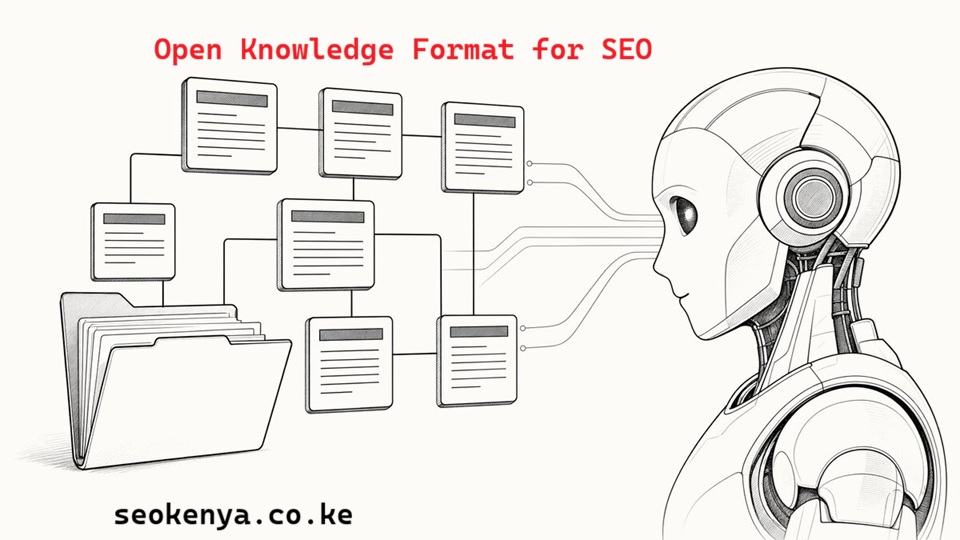
Open Knowledge Format (OKF) is an open standard by Google designed to represent metadata, context, and curated insights surrounding data. OKF uses a directory of simple markdown files, each containing a YAML frontmatter block for structured metadata.
This design makes information both human-readable and machine-parseable.
The format's core principles ensure knowledge is readable by people without special tooling and parseable by AI agents without custom software.
OKF content is also trackable in version control systems like Git and portable across different systems. The format standardises the minimum structural conventions for interoperability, leaving the specific content flexible.
How OKF Boosts SEO and Semantic Understanding
OKF directly improves search engine optimisation by facilitating machine readability. Search engines and AI agents that parse your content as structured knowledge gain a deeper semantic understanding of your business, products, and expertise.
This structured knowledge signals your site's authority and relevance.
Kenyan businesses receive tangible benefits from this approach. It enhances Expertise, Authoritativeness, and Trustworthiness (E-A-T) signals and improves content discoverability for local queries.
It also increases the likelihood of your content being used to generate direct answers in search results.
How to Implement Open Knowledge Format on Your Website
Implementing Open Knowledge Format involves creating organised text files that represent core business concepts. The process does not require complex tooling, making the concepts understandable to both people and search algorithms.
Creating Your First OKF Knowledge Bundle
A knowledge bundle is a folder containing your OKF files. To begin, create a markdown file (e.g., `services/mpesa-integration.md`) and add a YAML frontmatter block at the top.
This block contains key-value pairs that define the concept.
An example service concept for a Kenyan IT consultancy includes the following YAML frontmatter:
---
type: Service
title: M-Pesa API Integration
description: Development services for integrating M-Pesa APIs into web and mobile applications.
resource: https://www.mycompany.co.ke/services/mpesa-integration
tags: [mpesa, fintech, api, development, kenya]
timestamp: 2026-07-15T10:00:00Z
---
Structuring Content for Machine Readability
The body of the markdown file contains the details. Use standard markdown headings (`#`), lists, and tables to structure the information.
Use bundle-relative links to connect related concepts, such as linking a service to a case study (`See our work with [Client X](/case-studies/client-x.md)`). Adding a `# Citations` section with links to authoritative external sources strengthens the document's credibility.
Open Knowledge Format Compared With Schema.org
Open Knowledge Format and Schema.org serve different purposes for structured data. The primary differences are outlined in the table below.
| Comparison Point | Open Knowledge Format (OKF) | Schema.org |
|---|---|---|
| Purpose | Represents an entire knowledge base of concepts. | Marks up specific data points on a single web page. |
| Format | Directory of markdown files with YAML frontmatter. | JSON-LD, Microdata, or RDFa embedded in HTML. |
| Complexity | Minimal. Human-readable and writable. | Moderate. Requires specific syntax and validation. |
| Flexibility | High. Producer defines types and fields. | Low. Follows a fixed, centrally-managed vocabulary. |
| Primary Benefit | Creates a portable, agent-consumable knowledge graph. | Enables rich snippets and specific search features. |
| Primary Use Case for Kenyan Business | Building a central, version-controlled source of truth about services, products, and expertise. | Marking up local business info, products, and events for immediate SERP features. |
Advantages of OKF for AI-Driven Search
The primary advantage of Open Knowledge Format is its design for direct consumption by AI agents and Large Language Models (LLMs).
Schema.org annotates data for search crawlers, whereas OKF builds a self-contained knowledge base that an AI can ingest directly as it is a collection of simple text files.
Its minimalism and diffability in version control systems like Git make it ideal for creating LLM "wiki" repositories.
A Kenyan business can use OKF to build and manage its official knowledge, feeding the next generation of AI-driven search engines for improved accuracy.
Long-Term Benefits of OKF for a Kenyan Business
Adopting OKF is a strategic investment in future-proofing your digital assets. It prepares your business for an internet where AI agents, not just human users, are a primary audience.
This preparation ensures your knowledge is accurately represented in AI Overviews and other generative search experiences.
The resulting data interoperability improves your E-A-T signals for Google's search algorithms. It provides a competitive advantage in a digital market that increasingly values structured, verifiable, and machine-readable knowledge.
Practical OKF Examples for Kenyan Businesses
Kenyan businesses can apply Open Knowledge Format to a variety of content types to improve their semantic structure and discoverability. The following examples show practical applications for common business needs.
Optimising Local Business Data with OKF
A restaurant in Nairobi can create a concept file to serve as a single source of truth for its business information.
This file can describe services, link to its Google Business Profile, and detail location-specific information. This structured data improves clarity for local searches like "swahili food near me".
Enhancing Product and Service Descriptions
An e-commerce business selling Kenyan artisan crafts can use OKF to add rich, semantic context to its products.
Each product can have its own concept file detailing the artisan, materials used, and cultural significance, linking out to the main product page. This provides deep context that search engines use to understand product value.
Structuring Blog Posts and Knowledge Base Articles
A marketing agency in Mombasa can use OKF to structure its informational content. Each blog post becomes a concept with frontmatter defining its type, tags, and a summary.
The body can then link to related service concepts (`/services/local-seo.md`) or case studies, building a topical web of authority.
Tools for Managing OKF Content
The tooling for OKF is intentionally minimal, making it highly accessible for Kenyan small and medium-sized enterprises (SMEs). A standard text editor is sufficient for creating and editing the markdown files.
A free Git repository on a platform like GitHub or GitLab is recommended for version control and collaboration.
This "metadata as code" approach allows your business knowledge to be managed with the same rigour as software. It can be stored in a subdirectory of your main website repository, integrating directly into existing workflows without a separate database.
Key Facts about Open Knowledge Format for SEO
The table below summarises the most important details about implementing Open Knowledge Format for your business.
| Aspect | Description |
|---|---|
| Core Technology | Markdown files with YAML frontmatter. |
| Primary SEO Benefit | Creates a machine-readable knowledge graph for AI. |
| Required Tools | Text editor and a Git repository (e.g., GitHub). |
| Main Alternative | Schema.org (for on-page markup, not knowledge bases). |
How a Kenyan Business Can Start Using Open Knowledge Format
A business can start its OKF implementation by focusing on a single, high-value area to build a pilot knowledge bundle and measure the impact.
- Identify a Pilot Project: Select a core area, such as your primary services or product categories.
- Create the Bundle Structure: Make a new folder (e.g., `/knowledge/`) in your project and create sub-folders for concepts like `/services/` and `/case-studies/`.
- Author Your First Concept: Write a `.md` file for your most important service. Add the required `type` field and other relevant frontmatter like `title` and `description`.
- Build Connections: Write a second, related concept file (e.g., a case study) and add a markdown link between the two.
- Track Performance: Monitor Google Search Console for changes in impressions and clicks for the pages referenced in your OKF `resource` fields.
How Open Knowledge Format Affects Local SEO in Kenya
Open Knowledge Format provides specific advantages for local SEO strategies within Kenya. Businesses create unambiguous concepts for each location, service area, and local offering, which provides clear signals to search engines.
This method is effective for businesses in Nairobi, Mombasa, or Kisumu targeting location-based queries.
This structured approach strengthens local E-A-T signals and adapts well to the mobile-first content consumption that dominates the Kenyan market.
Clear, concise, and machine-readable information is processed more efficiently, leading to better visibility in local map packs and service-based search results.