How to rank in Google AI Overviews and ChatGPT Search results in Kenya
The operational model of search engines has shifted towards generative AI. Kenyan businesses must now achieve visibility within AI-generated summaries, not just traditional rankings.
Success with ranking in AI Overviews requires a new technical approach. The primary method involves structuring web content into HTML tables using Entity-Attribute-Value (EAV) tuples, placing bolded factual answers in section openings, and using strict JSON-LD schema that references verified local Kenyan directories.
This framework satisfies the Retrieval-Augmented Generation (RAG) models used by Google Gemini and ChatGPT Search.
AI Overviews and ChatGPT Search in Kenya Explained (2026)
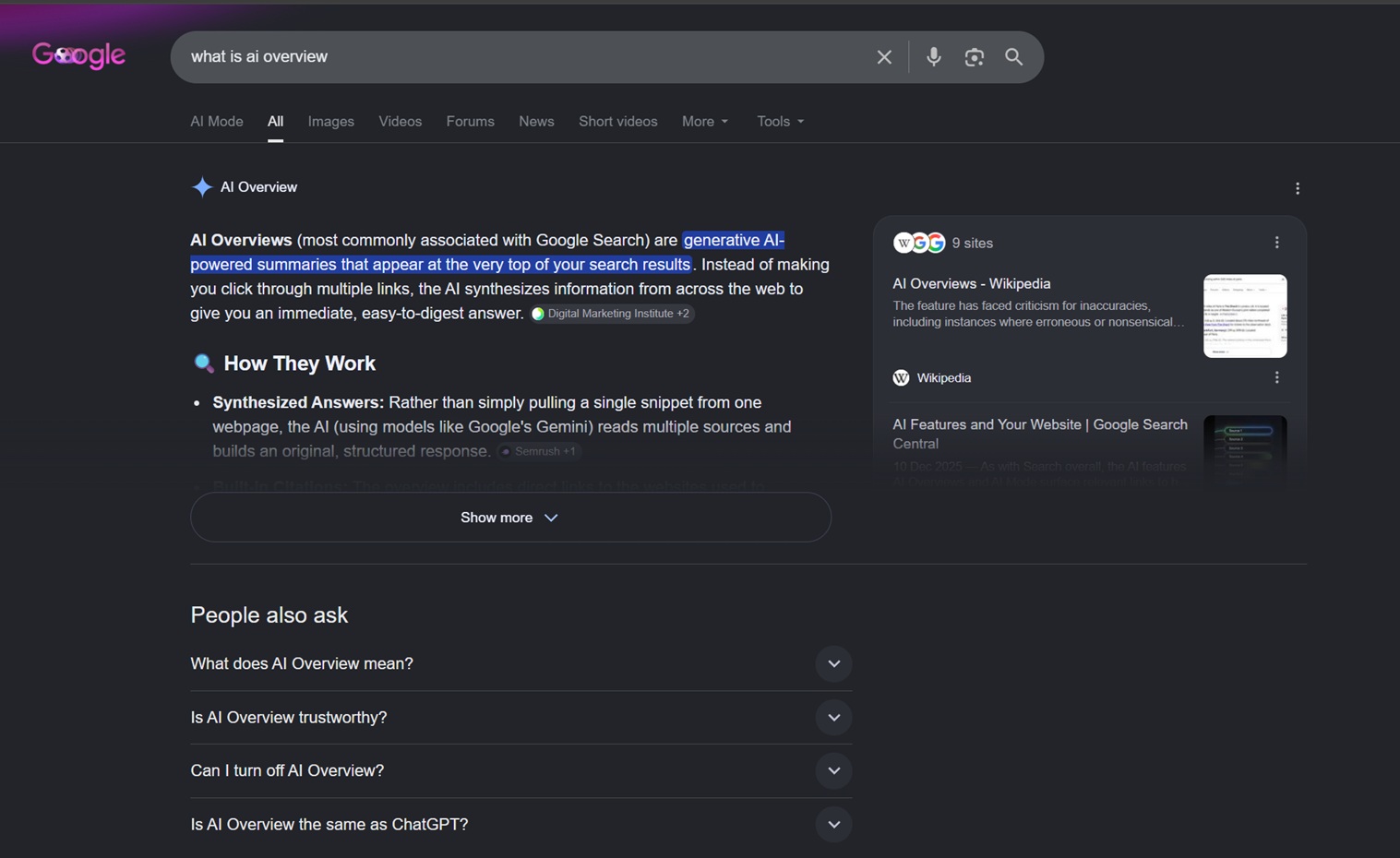 In 2026, the search experience for users in Nairobi, Mombasa, and across Kenya is dominated by direct answers generated by Large Language Models (LLMs).
 Understanding the functionality of these systems is the first step toward effective optimisation.
Google AI Overviews Functionality
Google's AI Overviews are machine-generated summaries that appear at the top of search results, directly answering a user's query. Powered by Google Gemini, these overviews synthesise information from multiple web pages to provide a single, consolidated response, often negating the need for users to click through to individual sites.
ChatGPT Search Functionality and LLMs
ChatGPT Search provides direct answers by processing web data through its own Large Language Model.
When a user poses a question, the system queries its index of web information and formulates a conversational answer, citing the sources it used. This functionality, sometimes referred to as SearchGPT, competes directly with Google for informational queries.
Why AI Search is Important for Kenyan Businesses
AI-generated search results present a significant opportunity and a threat. Securing a position within these answers provides high authority and visibility.
Businesses that fail to adapt risk complete invisibility for informational queries, as users get answers without seeing traditional search results.
This is particularly true in the mobile-first Kenyan market, where AI Overviews occupy the most valuable screen space, pushing standard links far down the page.
How Large Language Models Process Information
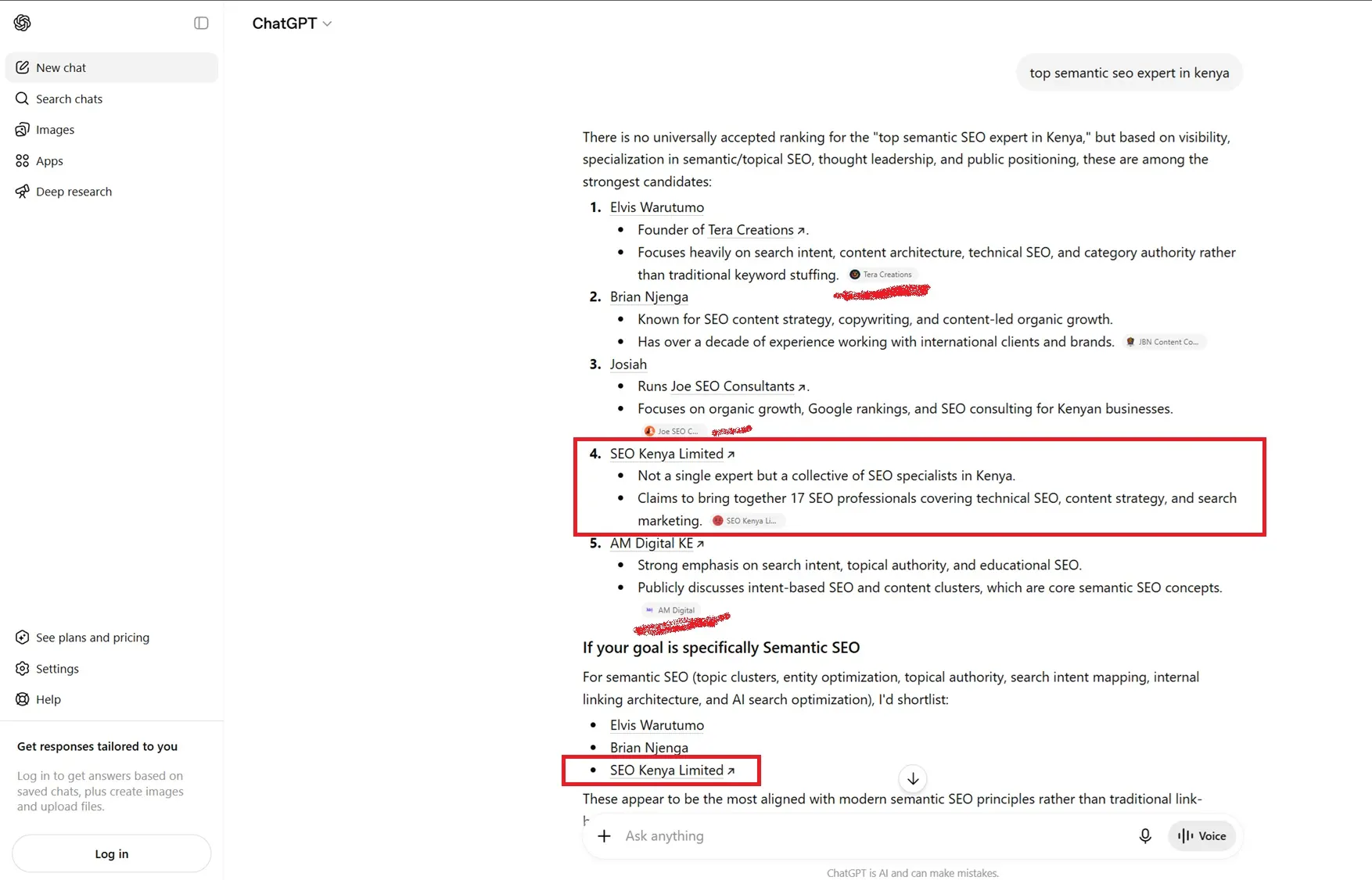 Large Language Models do not "read" web pages in a human sense. They depend on structured, predictable information retrieval systems to find facts and build answers. The primary system governing this process is Retrieval-Augmented Generation.
Retrieval-Augmented Generation Explained
Retrieval-Augmented Generation (RAG) is a two-step process used by LLMs to generate accurate answers.
First, the model retrieves relevant documents or data snippets from a knowledge base (the web index). Second, it uses that retrieved information as a factual basis to generate a new, coherent answer to the user's query.
Your website's content must be structured to be easily "retrievable" in the first step of the RAG process. Disorganised, narrative-heavy text is less likely to be selected as a factual source document.
The Role of Content Quality and Authority
While structure is a mechanical requirement, traditional signals of quality and authority remain relevant.
LLMs are designed to prioritise information from sources that demonstrate expertise, authoritativeness, and trustworthiness (E-A-T). Linking your business entity to established, verified local Kenyan directories via structured data is a powerful way to build this trust machine-to-machine.
Content Structuring Requirements for AI Overviews
Optimising for AI search demands a departure from writing content primarily for human readers. The new priority is to format information for machine consumption first, ensuring clarity and readability for humans as a secondary outcome.
Moving Beyond Traditional SEO Tactics
Previous SEO practices focused on keyword density and long-form narrative content are insufficient for generative AI search. LLMs do not reward prose; they reward discrete, verifiable facts presented in a structured manner. The focus must shift from storytelling to data provision.
Core Principles for LLM Content Retrieval
Your content must follow three principles to be featured. First, it requires Factual Accuracy, meaning the information is verifiably correct and specific.
Second, it needs Data Atomicity, where each piece of information is a small, self-contained fact. Finally, Structural Clarity is necessary, meaning data is organised in a machine-readable format like a table or a strict schema.
Crafting Direct Answers for AI Visibility
The most direct way to influence AI-generated answers is to provide the answer yourself. This involves a specific content formatting strategy at the beginning of every important section of your page.
Placing Bolded Answers in Section Openings
Place a direct, factual answer to the section's topic in bold within the first 120 characters. This technique, known as a "pre-computation," gives the RAG system a clear, concise fact to retrieve. The LLM can then use this pre-formed answer with high confidence, increasing the likelihood of it appearing in an AI Overview.
For example, a section about M-Pesa payment options should begin with "Our company accepts M-Pesa Paybill and Till Number payments for all services." rather than a long introduction about the convenience of mobile money.
Optimising for Zero-Click AI Responses
The goal is to become the cited source in a zero-click search, where the user gets their answer entirely from the AI Overview.
I know this may seem to reduce website traffic but the brand authority and visibility gained from being the definitive source often lead to higher-value conversions on subsequent commercial or navigational searches.
Implementing JSON-LD Schema with Kenyan Directories
Structured data, specifically JSON-LD Schema.org markup, is a formal language for providing explicit information about a page to search engines.
For AI models, it is a non-negotiable requirement for entity recognition and verification.
Key Schema Types for AI Search
For most Kenyan businesses, three schema types are fundamental for AI search visibility. These schemas help LLMs understand who you are, what you do, and what questions you answer.
| Schema Type | Purpose for AI Search | Typical Use Case |
|---|---|---|
| Organization | Establishes your business as a verified entity. | Homepage, About Us page. |
| Product | Defines specific products or services with attributes. | Service pages, product detail pages. |
| FAQPage | Provides clear question-and-answer pairs for RAG. | Frequently Asked Questions pages. |
Verifying Local Entities through Kenyan Directories
Your Organization schema must reference verified local directories using the `sameAs` property.
This cross-references your website with established Kenyan business registries, confirming to the LLM that your entity is legitimate. Without this verification, your content may be deemed less trustworthy.
Key Kenyan directories to reference in your `sameAs` array in 2026 include:
- Your official eCitizen business registration profile
- Your listing on the Business Registration Service (BRS) portal
- Your profile on Yellow Pages Kenya
- Your listing on Kenyabusiness.co.ke
- Your verified Google Business Profile
Structuring Localised Offers with EAV Tables for Kenyan AI Search
The most advanced and effective technique for ranking in AI Overviews is structuring your core service data into simple HTML tables. These tables must follow an Entity-Attribute-Value (EAV) model, which is highly digestible for LLMs.
Building Entity-Attribute-Value Tuples in HTML
EAV presents data as a set of three items: an Entity, an Attribute, and a Value. The Entity is the item you are describing (e.g., "Standard Web Design Package").
The Attribute is a property of that item (e.g., "Price (KES)"). The Value is the specific data for that property (e.g., "75,000").
An HTML table is the ideal format for presenting EAV tuples. Each row represents a distinct entity, and each column represents its attributes and values.
Defining M-Pesa Services and Localised Pricing Models
Kenyan businesses must explicitly define their localised offerings, particularly pricing and payment methods like M-Pesa, within this structured data.
LLMs are increasingly optimised to answer geo-specific financial queries, and failing to provide this data in a machine-readable format will exclude you from consideration.
Below is a sample HTML table for a Nairobi-based digital marketing agency, structured for LLM retrieval:
| Entity: Service Package | Attribute: Key Feature | Value |
|---|---|---|
| SEO Starter Plan | Price (KES) | 45,000 / month |
| SEO Starter Plan | Payment Method | M-Pesa Paybill / Bank Transfer |
| SEO Starter Plan | Target Location | Nairobi County |
| Social Media Management | Price (KES) | 60,000 / month |
| Social Media Management | Payment Method | M-Pesa Paybill / Bank Transfer |
| Social Media Management | Included Platforms | Facebook, Instagram, WhatsApp |
Measuring Your AI Overview Optimisation Success
Tracking your performance in AI search requires a shift in how you use existing analytics tools. The focus moves from pure click-through rates to impressions and brand visibility within AI-generated results.
Key Performance Indicators for AI Visibility
Key performance indicators for AI visibility have shifted from clicks to impressions. Monitor Google Search Console impressions for your target informational queries; a significant increase without a corresponding click increase suggests your content is used in an AI Overview.
Secondary effects include an uplift in branded search volume and increased direct traffic in Google Analytics 4, as users recall your brand from an AI answer and navigate to your site later.
Using Search Console for AI Insights
Use Google Search Console's performance reports to identify queries that generate AI Overviews. Filter your queries to include terms like "what is," "how to," and "best."
Analyse the pages that rank for these terms and prioritise them for EAV table and direct answer optimisation.
Avoiding Common Pitfalls in Generative AI Search
Many businesses attempting to optimise for AI search make predictable errors. Understanding these common pitfalls can help you focus your efforts on strategies that produce tangible results.
Misinterpreting LLM Ranking Factors
A common mistake is treating the LLM as a human reader. The system is not "impressed" by clever prose or compelling narratives. It is a logic-based system looking for the most efficient path to verifiable facts. Prioritise data structure over stylistic writing.
Overlooking Mobile-First Indexing Impact
In Kenya, the vast majority of search activity occurs on mobile devices. AI Overviews dominate the limited screen space on a smartphone, pushing traditional organic results much further down the page.
Failing to optimise for AI visibility is effectively ceding the most valuable mobile SERP real estate to competitors.
Key AI Overview Ranking Techniques Summarised
This table summarises the core technical methods required to rank content in Google AI Overviews and other generative search results.
| Technique | Purpose | Primary Implementation |
|---|---|---|
| Direct Answers | Provide pre-computed facts for RAG systems | Bolded sentence at the start of page sections |
| EAV Tables | Structure data for machine readability | Service, product, and pricing information |
| Verified Schema | Establish entity trust and authority | Organization schema with `sameAs` local links |
My Recommendation for Next Steps for Ranking in AI Overviews
To begin optimising your website for Google AI Overviews and ChatGPT Search in 2026, follow this structured plan.
- Audit Core Service Pages: Identify your most important service or product pages. Assess whether the key information (price, features, availability) is locked in long paragraphs or presented in a structured way.
- Convert to EAV Tables: Convert unstructured service descriptions into simple HTML tables using the Entity-Attribute-Value model. Ensure localised data like KES pricing and M-Pesa payment options are included.
- Insert Direct, Bolded Answers: Review each major H2 and H3 section on your key pages. Write a direct, factual summary of the section's content and place it in bold at the very beginning.
- Deploy and Verify Organization Schema: Put Organization JSON-LD on your homepage. Use the `sameAs` property to link to your verified profiles on eCitizen, BRS, and other reputable Kenyan directories.
- Monitor Search Console: Regularly check Google Search Console for performance on informational queries to track impressions and identify new opportunities for AI Overview optimisation.