AI Overviews Citing Non-Top 10 Google Rankings
AI Overviews frequently cite content from pages ranked outside the top 10 Google search results. Recent analysis shows over 67% of cited pages do not appear in the top 10. The data challenges conventional SEO for Kenyan businesses.
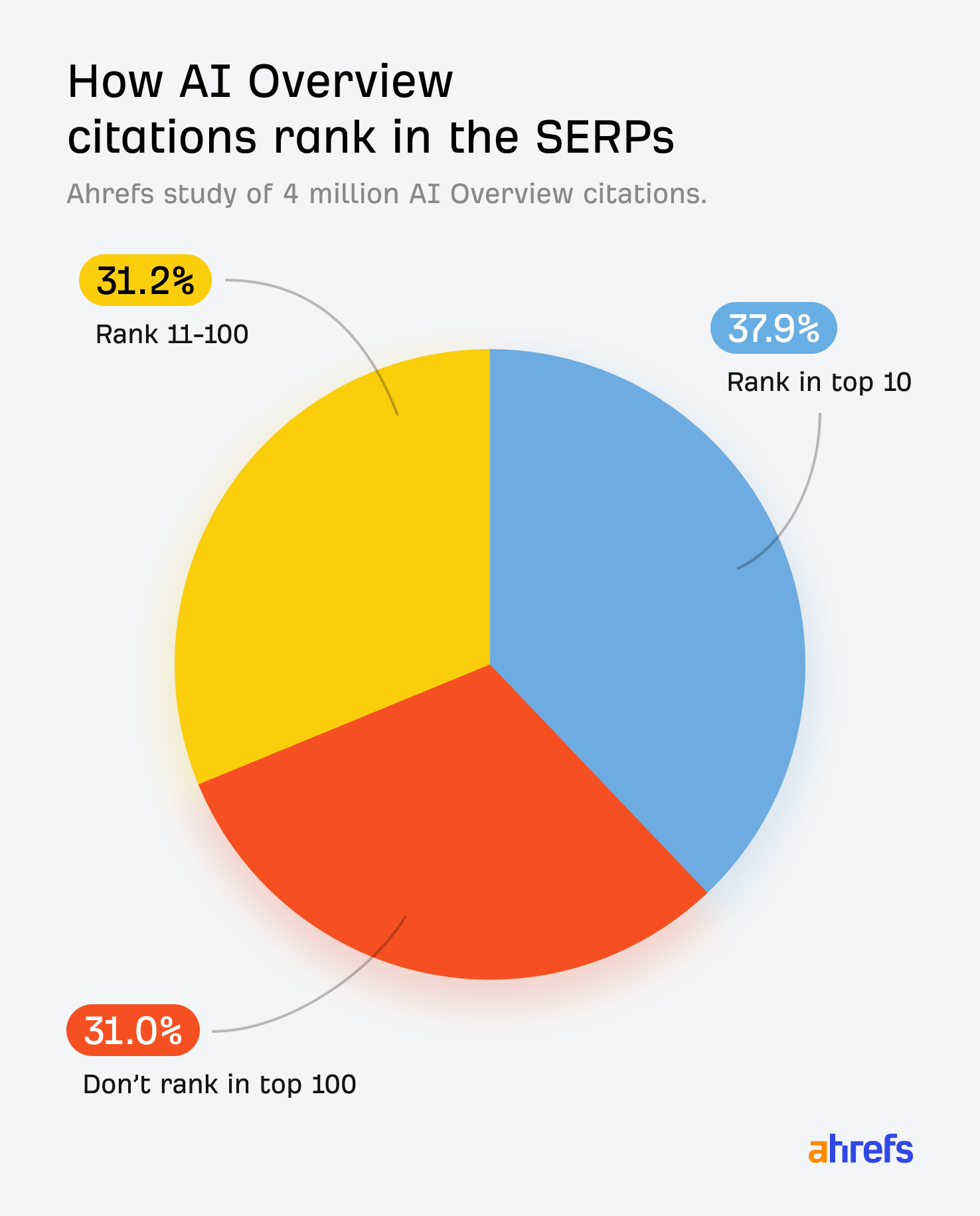
Image source: Ahrefs Study on AI Overviews
This search behaviour changes the focus for 2026 from strict ranking position to semantic relevance. Businesses must adapt their content strategy to prioritise topical authority over simple keyword targeting.
How AI Overviews Find Content Outside the Top 10
Google's generative AI uses semantic matching instead of traditional ranking signals like link authority. The AI deconstructs a user's query to understand its intent and related entities. The AI then searches its index for the most direct and accurate answer, irrespective of the source page's overall ranking.
A page on the second or third page of results can be cited if it contains a clear paragraph or a specific data point. The AI may select this snippet as the most relevant answer for a part of its generated response. This mechanism prioritises informational accuracy over domain authority for a given query.
For a Kenyan business, this function provides a specific opportunity. A site without page-one authority for "business loans Kenya" can still be cited. An article detailing "chama loan application requirements" can be selected by the AI as the best source for that specific information.
Optimising Content for AI Overviews in Kenya
An effective content strategy for AI Overviews shifts from targeting singular keywords to establishing topical authority. The objective is to create content that serves as an authoritative resource for an entire user journey. This approach requires creating one in-depth pillar page instead of five separate, shallow blog posts.
A clearing and forwarding business in Mombasa should move beyond a simple services page. A practical approach is building a content cluster around a "Kenya Import Guide" pillar page. This central page links to detailed articles on sub-topics like "KEBS Pre-Export Verification" and "Calculating Import Duty in Kenya," which signals deep expertise to Google's AI.
Content Traits That Attract AI Overview Citations
AI Overviews prefer content that shows strong Expertise, Authoritativeness, and Trustworthiness (E-A-T). E-A-T translates into specific content attributes like factual accuracy and unique insights supported by data. The AI also prioritises content with exceptional clarity.
Content must have a logical structure with clear headings. Answers to potential user questions should be concise and direct. A boutique advisory firm in Nairobi demonstrates E-A-T by publishing a detailed analysis of new KRA tax amendments. The article's value comes from its specificity and verifiable expert authorship.
The clarity of the explanation and the directness of the advice make the content easy for the AI to synthesise and cite. This combination of expertise and clarity earns the citation, not keyword optimisation alone.
Competitive Strategy for AI Overviews in Kenya
The ability of AI Overviews to cite deep-ranking pages changes the competitive environment in Kenya. The change gives an opportunity to smaller businesses with niche expertise. These businesses can gain visibility against larger competitors who rely on high domain authority.
A large competitor may rank first for "Nairobi real estate" with generic content. A smaller agency can be cited by publishing a detailed report on "Rental Yields in Kilimani vs. Westlands for 2026." The AI Overview bypasses the top ranker to cite the more specific, expert content.
Your strategy should include identifying content gaps that larger competitors have overlooked. Focus on becoming the expert on a specific sub-topic. This approach shifts competition from link-building budgets to genuine expertise and content quality, allowing specialised businesses to compete nationally on informational queries.
Technical SEO That Supports AI Overview Citations
Technical SEO provides the foundation that allows Google's AI to find and understand your content. A clean site architecture with strong internal linking is important. Internal links establish the semantic relationships between your pages and reinforce topical authority.
Structured Data Implementation
The use of structured data (Schema.org markup) is an important technical factor. Implementing schema types like `FAQPage`, `HowTo`, and `Article` gives explicit context to search engines about your content. This markup makes it easier for the AI to parse and extract information for a citation.
Page Experience Signals
A good page experience remains a foundational signal of a quality site. Fast load times, measured by Core Web Vitals, indicate a trustworthy user experience. Google's systems use these signals as part of their overall quality assessment.
Measuring AI Overview Citation Success
Measuring success with AI Overviews requires a change in analytics. Traditional rank tracking for a few keywords is no longer a sufficient performance indicator. The primary tool for measurement is Google Search Console.
Analyse impressions and clicks for queries in the Performance report where your site appeared in an AI Overview. Look for search appearances labelled "Cited in AI Overview." Tracking these appearances shows the visibility your content is gaining from citations.
Supplement this data with qualitative analysis. Periodically search for your main topics and review the AI-generated responses. Note when your site is cited and the context of the citation. This analysis provides direct insight into the content that resonates with the AI.
Content Types With the Most AI Overview Citations in Kenya
Certain content formats are more effective for securing AI Overview citations in the Kenyan market. These formats align with the AI's need for structured and clear answers. Businesses should prioritise creating the following content types:
- In-depth 'how-to' guides: Detail local processes, such as "How to get a KRA PIN for a new business." These guides provide sequential, actionable steps.
- Detailed comparison articles: A "Safaricom Home Fibre vs. Zuku in Nairobi" analysis directly addresses high-intent comparative queries.
- Well-structured FAQ pages: Answer a cluster of related questions on a single topic to provide concise, extractable snippets for the AI.
- Data-driven local reports: An analysis of real estate trends in Mombasa offers original, authoritative information that establishes your business as a primary source.
How Multilingual Queries Affect AI Overviews in Kenya
A unique factor in the Kenyan market is the use of mixed-language queries involving English, Swahili, and Sheng. AI Overviews increasingly understand the intent behind these searches. A search for "best way to send pesa home" is understood to relate to money transfer services.
Your primary content can be in English, but its relevance is improved by an awareness of this linguistic context. The improvement does not come from adding Swahili keywords. It comes from creating content that is culturally relevant.
An article about public transport in Nairobi should naturally use and explain terms like "matatu" and "bodaboda." This usage demonstrates a deep understanding of the local context that the AI can recognise and reward with a citation.
How to Adapt Your SEO Strategy for AI Overviews
Kenyan businesses must take structured action to compete for AI Overview visibility in 2026. The first step is a content audit to identify topical gaps and opportunities for building depth. Evaluate existing content on its authority, not its keyword ranking.
Next, refine your content creation workflow. Shift focus from producing many shallow articles to creating fewer, more authoritative pillar pages. Your keyword research must also evolve to prioritise user questions, long-tail queries, and the semantic entities related to your core topics. This strategic change to a topic-centric model is the core adaptation required.
| Strategy Component | Action for Kenyan Businesses | Expected Outcome |
|---|---|---|
| Content Audit | Identify gaps in topical authority, not just keyword rankings. | A clear roadmap for creating in-depth content. |
| Content Creation | Focus on pillar pages and content clusters over single blog posts. | Increased semantic relevance and citation potential. |
| Keyword Research | Prioritise user questions and long-tail informational queries. | Content that directly answers AI-serviced queries. |
| Technical SEO | Implement `Article`, `FAQPage`, and `HowTo` schema. | Improved content discoverability and parsing by AI. |
Why Topical Authority Is the Future of SEO in Kenya
The function of AI Overviews to cite content from deep search results is the new reality of organic search. Businesses across Kenya, from tech startups in Nairobi to tourism operators in Mombasa, risk their future online visibility by waiting to adapt.
Shifting your SEO strategy from a narrow focus on page-one rankings to a broader pursuit of topical authority is a requirement for 2026. Investing in high-quality, expert-driven content that serves user intent positions your business as a trusted source for users and Google's generative AI. This investment improves your competitive position.
[Book an SEO strategy consultation]