Key On-Page SEO Factors for Keyword Relevance
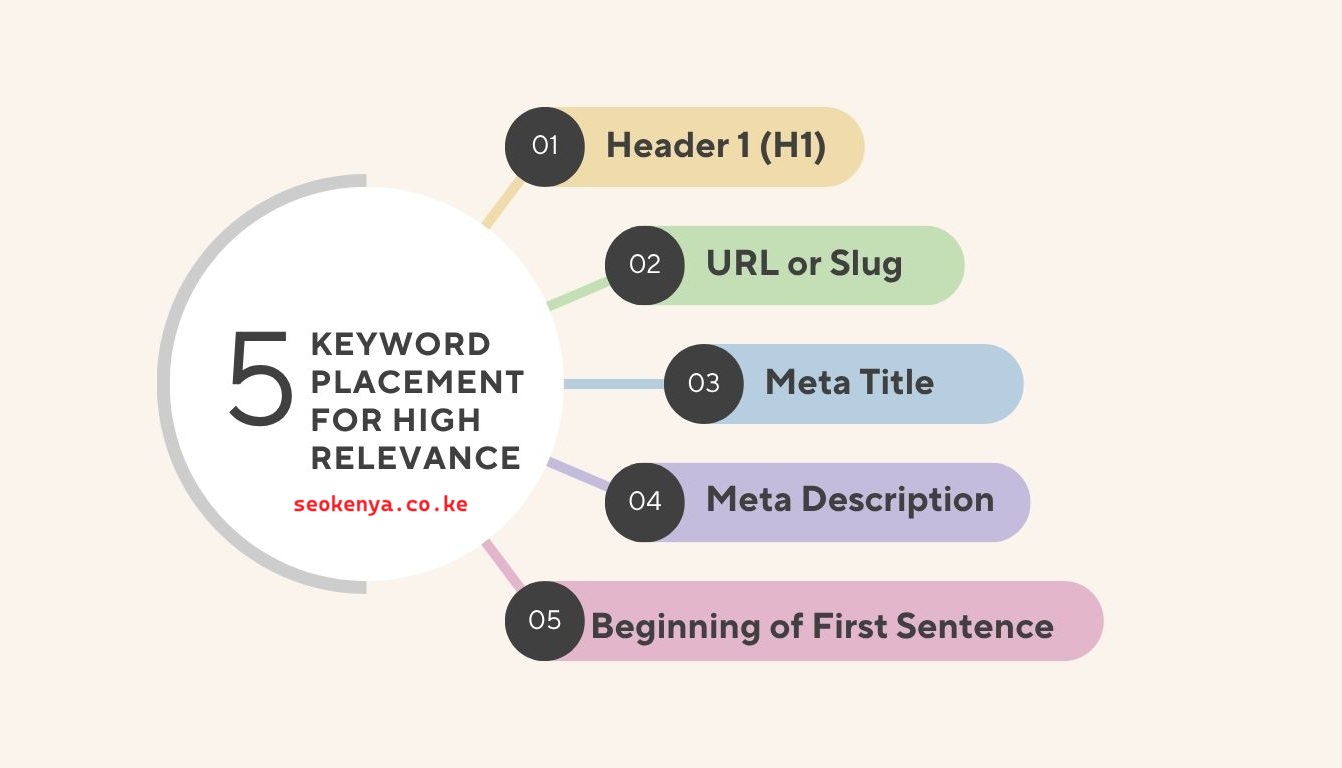
The core of on-page SEO relevance is the precise placement of a target keyword in four high-impact locations.
These locations are the page title, the URL slug, the primary H1 tag, and the beginning of the first sentence. These placements act as direct signals to search engines, communicating a page's primary topic.
This focus helps enhance organic visibility for Kenyan businesses by ensuring content aligns with user search queries.
Why Specific Keyword Placements Matter More Than General Mentions
Search engines use specific on-page elements as strong topical signals. High-quality content provides the foundation, but precise keyword placement offers greater impact.
Placing a target keyword in the page title, URL, H1 tag, and first sentence sends a clear, hierarchical message about the page's core subject.
This method has a more direct impact on keyword relevance for Google rankings than general keyword density within the body text.
Impact of the page title and URL slug on keyword relevance
The page title is a primary relevance signal for search engines and directly affects the click-through rate (CTR) for Kenyan users.
A clear title containing the target keyword confirms the page's content is relevant to a user's query.
The URL slug supports this topical alignment. A slug like `yourdomain.co.ke/solar-panels-nairobi` provides strong semantic context, whereas a generic slug like `yourdomain.co.ke/page-id-234` does not.
How H1 tag Keyword Placement affect SEO Relevance
The H1 tag is the main on-page heading and acts as a primary relevance indicator for search engine crawlers.
The H1 reinforces the message established by the page title, creating a consistent signal about the content's focus.
Each page requires a single, unique H1 tag that includes the target keyword. This structure solidifies the page's perceived relevance and provides clarity for users.
Why Keyword Placement in the First Sentence Matters
Placing the target keyword at the start of the first sentence establishes immediate semantic context. This placement allows Google's algorithms to understand the page's main topic quickly without parsing large amounts of text.
This immediate confirmation of relevance improves user experience and engagement signals, which is important for Kenyan audiences who often scan content.
Common Mistakes that Affect On-page Keyword Relevance
Businesses can improve performance by avoiding several common on-page optimisation errors.
- Keyword Stuffing: Forcing the keyword into the text unnaturally, which harms readability and can lead to ranking penalties.
- Neglecting Local Variations: Failing to use location-specific keywords such as "accountants in Mombasa" or "car hire Kisumu".
- Ignoring User Intent: Optimising for a keyword without creating content that satisfies what the user is looking for.
- Over-optimisation: Creating titles and headings that sound robotic and deter clicks from actual users.
- Using Outdated Tactics: Relying on old practices like keyword density instead of focusing on relevance signals and content quality.
Measuring the Effect of On-Page Relevance Work
Tracking the impact of on-page optimisations requires monitoring specific metrics. Key performance indicators include changes in organic traffic, improvements in keyword rankings, and fluctuations in impressions and click-through rates (CTR).
Analytics tools like Google Analytics 4 are needed to measure this performance accurately after making changes.
How to Use Google Search Console for Relevance Insights
Google Search Console provides direct performance data for a website. Its Performance report shows the exact queries for which your pages are ranking.
After changing a page's title, H1, or URL, you should monitor this report to track the average position and CTR for your target keyword. An increase in both metrics indicates your changes have improved relevance.
Other on-page factors support keyword relevance
Several other on-page elements support overall authority and relevance beyond the four core placements.
A structured internal linking strategy connects related content, distributes authority, and helps search engines understand a site's structure.
High-quality image alt text that describes the image and includes relevant keywords provides context for visual content.
Schema markup (structured data) gives search engines explicit information about your content, which can help enhance visibility in search results.
On-Page Relevance Factors in Mobile-First Indexing
Mobile-first indexing is standard in Kenya, where mobile internet access dominates.
The immediate visibility of relevance signals is important because users often view search results on small screens with limited data bundles.
Concise page titles and clean URL slugs containing the keyword are more likely to be fully visible in mobile search snippets. This clarity attracts clicks and helps retain engagement from mobile users across Kenya.
Key On-Page SEO Factors at a Glance
| On-Page Element | Primary Purpose | Best Practice Example |
|---|---|---|
| Page Title | Main signal for SERP relevance and CTR | Solar Panels Nairobi | Company Name |
| URL Slug | Provides semantic context and structure | /solar-panels-nairobi/ |
| H1 Tag | Confirms the page's primary topic | Solar Panels for Sale in Nairobi |
| First Sentence | Establishes immediate topical focus | Our company supplies solar panels in Nairobi... |
How to Implement an On-Page Keyword Relevance Strategy
An on-page strategy begins with keyword research to identify the primary term for each page.
You should then audit existing pages, checking the page title, URL, H1 tag, and first sentence for the target keyword.
Update these elements methodically to ensure changes are natural and improve clarity for the user. This checklist can be integrated into the standard process for publishing new content.
[Get on-page SEO services from SEO Kenya]How to Sustain High Keyword Relevance Over Time
Maintaining high keyword relevance is an ongoing process. You must regularly review page performance in Google Search Console to identify pages with declining traffic or rankings.
Analysing competitors in the Kenyan market helps you understand their on-page strategies.
Refreshing your content every 12-18 months ensures it remains accurate and aligned with any changes in user search intent.