Leveraging Keyword Variations for SEO & Avoiding Stuffing
A keyword variation strategy is a requirement for Kenyan businesses in 2026 to achieve broad organic rankings and avoid stuffing penalties by moving beyond exact-phrase repetition.
A business builds topical authority by integrating diverse, semantically related terms. For example, using 'enterprise SEO expert' as a variation for 'enterprise SEO consultant' signals detailed expertise to Google's algorithms.
Keyword Variations for Kenyan Audiences
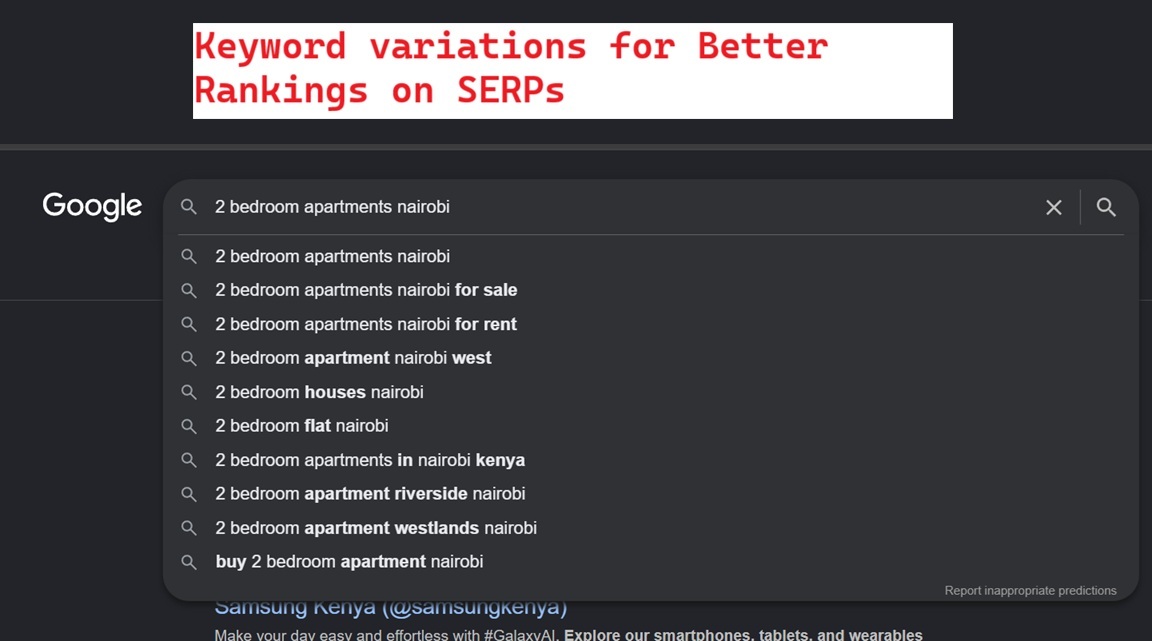
Keyword variations are alternative phrases that users search for to find information on a specific topic. These include synonyms, related terms, and long-tail phrases.
Diverse user intent drives the need for these variations; a person in Nairobi searching for "tech jobs" has a different need from someone in Kisumu searching for "entry-level IT support roles near me."
Understanding Different Types of Variations
Synonyms are words with similar meanings, like 'Nairobi apartment for rent' and 'flat to let in Nairobi'. Related terms are conceptually linked, such as 'M-Pesa agent' and 'mobile money services'.
Long-tail keywords are longer, more specific phrases, like 'how to make mandazi at home Kenya' instead of just 'maandazi recipe'.
Decoding Local User Intent and Search Behaviour
The Kenyan market has unique search behaviours that influence keyword variations. Mobile-first indexing means queries are often conversational and location-based.
Transactional intent is frequently linked to M-Pesa, with searches like "buy laptop with M-Pesa" being a common variation of "laptops for sale."
Understanding the specific 'why' behind a search in Kenya is a foundation for identifying effective variations.
Tools You can Use to Identify Keyword Variations in Kenya
Businesses identify effective keyword variations with a combination of free and paid tools.
These platforms help uncover the actual language and queries used by your target audience in the Kenyan market, moving from guesswork to data-backed content planning.
Using Google's Free Research Tools
Google Search Console is the most direct source for identifying variations. The 'Performance' report shows the actual search queries users make to find your website.
Google Keyword Planner provides initial variation ideas and search volume estimates, which helps gauge demand for different terms within Kenya.
Advanced Third-Party Platforms and SERP Analysis
Paid platforms like Ahrefs and SEMrush offer deeper insights into competitor keywords and content gaps, revealing semantic keywords you may have missed.
Manually analysing Google's Search Engine Results Pages (SERPs) is also effective. The 'People Also Ask' boxes and 'Related searches' section provide natural language queries and entity-based clues that reflect user intent.
How Modern Google Algorithms Evaluate Keyword Variations
Modern Google algorithms prioritise semantic relevance and topical authority over raw keyword density. These systems have evolved from simple string-matching to understanding concepts and context.
This shift means a page's value is determined by how thoroughly it covers a topic, not how many times it repeats a single keyword.
From Keywords to Entities and Semantic Search
Google no longer just matches keywords; it understands entities (people, places, things, and concepts) and their relationships.
A page that uses variations like "SGR schedule," "Madaraka Express booking," and "Nairobi to Mombasa train" demonstrates a deep understanding of the 'Kenya Railways' entity, which Google rewards with higher authority.
The Role of Context and Natural Language Processing
Natural Language Processing (NLP) allows search engines to interpret human language with its nuances, synonyms, and context.
By using diverse keyword variations, you provide Google with the necessary signals to understand that your content is a detailed resource on a subject, satisfying a wider range of user queries.
How You Integrate Keyword Variations Without Stuffing
The effective integration of keyword variations requires a focus on natural language and a positive user experience.
The goal is to create content that is valuable and readable, not to force in terms for SEO. This approach prevents keyword stuffing penalties and builds trust with your audience.
Strategic Placement and Natural Language
Place primary and secondary keywords in high-impact locations like the title tag, meta description, and H1/H2 headings.
Weave variations naturally into the body text, subheadings, and image alt text. The language should always flow smoothly and feel conversational, never forced or repetitive.
Focusing on User Experience Over Density
Write for your human audience first and the search engine second. Content must answer the user's query directly and provide value.
Keyword variations should support the main topic and add depth, not be inserted to meet an arbitrary keyword density percentage. High-quality content that satisfies user intent will always perform better.
How to Measure Keyword Variation Impact in Kenya
Kenyan businesses track the impact of a keyword variation strategy by monitoring key performance indicators in analytics tools.
Success is not just about ranking for one term but about improving overall organic visibility and traffic for a cluster of related search queries.
Tracking Broader Ranking Potential and Organic Traffic
Use rank tracking software or Google Search Console to monitor your position for a wide array of semantically related terms.
A successful strategy will show an increase in the total number of keywords your page ranks for. This should correlate with a measurable increase in organic traffic to the relevant pages in Google Analytics 4 (GA4).
Analysing User Engagement and Conversions
Better content relevance from using keyword variations leads to improved user engagement. Monitor metrics like time on page and bounce rate.
The ultimate goal is business impact, so track conversions such as form submissions, calls, or M-Pesa transactions that originate from organic search traffic.
Common Keyword Variation Mistakes Do Kenyan Businesses Make
Kenyan businesses often make predictable errors with keyword usage that stem from outdated SEO advice.
Common mistakes include over-optimisation and neglecting the unique linguistic context of the local market. These pitfalls can be corrected with a strategic content audit and a focus on natural language.
Over-Optimisation and Keyword Stuffing Pitfalls
Repeatedly forcing keywords and their variations into content creates a poor user experience and can trigger Google penalties.
A page about "property for sale in Mombasa" that awkwardly repeats "Mombasa real estate listings," "houses to buy in Mombasa," and "plots for sale Mombasa" will be flagged. To fix this, conduct a content audit to identify and rewrite unnatural phrasing, focusing on clear, helpful language.
Ignoring Local Dialects and Conversational Queries
A significant mistake is failing to incorporate Swahili or Sheng variations where appropriate. For a younger, urban audience in Nairobi, a search for "best mobile loans" might be phrased in Sheng.
Overlooking these local dialects means missing an opportunity to connect with a large segment of the potential search audience.
How to Structure Content for Keyword Variations
A well-organised site structure is a requirement for using keyword variations effectively.
Using a topic cluster model, where related content is grouped and interlinked, helps establish topical authority and makes it easier for both users and search engines to find relevant information.
Implementing a Topic Cluster Strategy
Create a central, pillar page for a broad topic (e.g., "Digital Marketing in Kenya"). Then, create multiple cluster pages that cover specific sub-topics in detail (e.g., "Facebook Ads for Kenyan SMEs," "SEO pricing in Nairobi," "Email marketing automation").
Each cluster page is optimised for a different set of related keyword variations, satisfying diverse user queries within the main topic.
Internal Linking for Semantic Depth
Strategic internal linking connects your pillar and cluster pages. Use descriptive anchor text to link between semantically related articles.
This practice distributes link equity across your site and sends strong signals to Google's algorithms about the depth and breadth of your expertise on a subject, reinforcing your topical authority.
Ways that Keyword Variations Capture Conversational Search in Kenya
A semantic approach to keywords is necessary to capture the rise of voice search and mobile-first indexing in Kenya. Users increasingly use conversational queries, often integrating Swahili and Sheng.
A successful strategy must use keyword variations that match this natural language.
A typed query might be "web design company Nairobi," while a voice search is more likely to be "ni kampuni gani poa ya kutengeneza website hapa Nairobi?" (which is a good company for making a website here in Nairobi?).
Key Components of a Keyword Variation Strategy
| Strategy Component | Example for Kenyan Market | Key Metric to Track |
|---|---|---|
| Synonyms | 'Nairobi apartment for rent' vs. 'flat to let in Nairobi' | Ranking for both terms |
| Related Terms | 'M-Pesa agent' and 'mobile money services' | Topical authority score |
| Local User Intent | "buy laptop with M-Pesa" | Organic conversion rate |
| Conversational Search | "web design company Nairobi" vs. "ni kampuni gani poa ya kutengeneza website" | Traffic from long-tail queries |
Developing Your 2026 Keyword Variation Action Plan
- Audit Existing Content: Review your top-performing pages for evidence of keyword stuffing or unnatural language. Identify opportunities to rewrite sentences and integrate semantic variations.
- Conduct Semantic Research: Use tools like Google Search Console and Ahrefs to build a list of primary keywords and their related variations, including synonyms, long-tail queries, and question-based searches.
- Map Variations to User Intent: Group your keyword variations by the user's likely intent (informational, transactional, navigational). Plan new content or update existing pages to directly satisfy each intent.
- Update Your Content Calendar: Prioritise content updates and the creation of new topic clusters based on your research. Ensure every new piece of content is written with a natural integration of keyword variations.
What to Look for in a Kenyan SEO Partner
A business seeking external assistance should select an SEO partner with proven expertise in semantic search. A capable partner understands the local Kenyan market, including consumer behaviour, mobile usage patterns, and linguistic nuances.
The partner should provide a clear strategy for improving organic rankings without using outdated tactics like keyword stuffing.