Prioritized SEO Content: Firsthand Experience, Local Relevance, & Unique Media
Content prioritisation based on firsthand experience is a required strategy for Kenyan businesses in 2026.
Google's algorithm rewards content that shows verifiable experience, local market relevance, and includes unique, custom media.
This approach moves content creation from generic articles to authentic material that proves real-world knowledge, which affects organic search rankings and competitive advantage in the Kenyan market.
How Google Define Firsthand Expert Experience for Kenyan Content
Google identifies firsthand expert experience through signals that prove an author has directly used a product, visited a location, or has hands-on knowledge of a topic.
A Kenyan business must show, not just tell. Signals include author credentials with experience in Kenya, case studies with verifiable local data, and content describing the "how" and "why" from an organisational perspective.
Actionable examples include a Nairobi logistics company publishing an article on navigating city traffic written by a senior driver. A software firm can show video tutorials of its product solving a problem specific to Kenyan SMEs.
Integrate Local Relevance Signals for SEO in Your Kenyan Business
Deep local market relevance makes content specifically valuable for a Kenyan audience. This is a component of E-E-A-T (Experience, Expertise, Authoritativeness, Trustworthiness) and local SEO.
It requires embedding Kenya-specific context, language, and cultural references that generic content cannot replicate, which shows Google that your content serves local user intent.
Kenya-Specific Examples and Case Studies
Businesses must ground their content in local reality. A Mombasa real estate agency should write about navigating land registry processes in Kilifi County, not a generic guide to buying property.
A tech startup in Nairobi can create a case study about helping a local business in Westlands overcome an operational challenge. An agribusiness in Kisumu could publish content on soil types specific to the Lake Victoria basin.
Using M-Pesa Examples to Show Local Authority
Discussing or demonstrating M-Pesa use cases is a clear signal of local market understanding. A financial services company can create a guide on using M-Pesa for business invoicing.
An e-commerce site can detail its M-Pesa checkout process with custom screenshots, addressing a core aspect of Kenyan commerce.
Effective Custom Media for Kenya SEO
Unique custom media includes original photography, bespoke infographics, and video testimonials from Kenyan clients. Google rewards pages with such media because it serves as evidence of firsthand experience and is more helpful to users than generic stock imagery.
A photo of your team installing solar panels in Nakuru provides more trust than a stock photo of anonymous workers, improving user engagement and organic traffic.

How Our SMEs Generate Firsthand Content with Limited Resources
Kenyan SMEs can generate expert-driven content cost-effectively. Conduct and record interviews with experienced technicians, sales staff, or long-term customers, then transcribe them into articles.
Create simple "how-to" videos using a smartphone to demonstrate a service process. 'Behind-the-scenes' content showing a manufacturing process provides authentic media that builds trust.
What Are the Measurable Benefits of Prioritising Experience-Driven Content?
The benefits for Kenyan businesses adopting this content strategy are quantifiable. This approach leads to improved search rankings for relevant local queries, which drives higher quality organic traffic.
Enhanced user engagement signals, such as longer time on page, are registered by Google as a positive quality indicator. This process builds brand authority, increases customer trust, and results in higher conversion rates.
How Should a Business Audit Content for E-E-A-T and Local Relevance?
A content audit is the first step to align existing assets with 2026 search expectations. Marketing managers review their content to identify weaknesses in E-E-A-T signals, local relevance, and use of unique media.
This process reveals opportunities for content improvement and optimisation.
Evaluating Existing Content for E-E-A-T Signals
Assess current content with direct questions. Is the author identified with an author biography detailing their Kenyan experience? Does the content include original insights?
Are claims supported by original data or firsthand accounts? Use this checklist to score each piece of content.
Identifying Gaps in Local Relevance and Unique Media
Review your blog posts and service pages to find where they lack Kenyan context. Identify every instance of generic stock photography and mark it for replacement.
Look for opportunities to insert local examples, such as referencing a Nairobi landmark in a guide or mentioning a county-specific regulation.
What Tools Help Create Unique Media and Verify Expertise in Kenya?
Accessible tools help Kenyan businesses create the unique media that Google's algorithm rewards. The focus should be on authenticity and relevance, not high production quality.
These platforms help you produce original assets and signal your expertise.
Platforms for Creating Unique Visuals and Video
Canva offers a user-friendly interface for creating custom graphics and data visualizations. A modern smartphone is sufficient for recording customer testimonials and product demonstrations.
Simple video editing can be done using apps like CapCut or InShot on a mobile device.
Verifying and Showcasing Expertise
Expertise is verified through clear attribution. Every article must have a detailed author bio linking to professional profiles like LinkedIn. Use structured data (Schema markup) to inform Google who the author is.
Regularly post updates and photos of your work on your Google Business Profile to reinforce local authority.
Why Google's Algorithm Prioritise Firsthand and Local Content
Google's recent algorithmic updates aim to reward content that is genuinely helpful and created by people with direct experience.
The prioritisation of firsthand experience, local relevance, and unique media is a core strategy shift. For SEO success in Kenya, creating content that meets these criteria is an operational requirement.
How Does This Content Strategy Affect Voice and Visual Search in Kenya?
The growth of voice and visual search in Kenya makes this content shift more important. Conversational, experience-driven content aligns with how people ask questions via voice assistants.
Unique, locally contextualised media is necessary for visual search. This makes your content a usability and accessibility feature for reaching a broader audience.
| Area of Focus | Action Required | Reason for Prioritisation |
|---|---|---|
| Expertise | Interview internal staff for content | Demonstrates real-world, firsthand experience |
| Local Relevance | Add Kenya-specific data and examples | Serves local user intent more accurately |
| Unique Media | Replace stock photos with original media | Provides verifiable proof of claims |
| Authoritativeness | Create detailed author bios with proof | Builds trust with users and search engines |
How to Develop a Prioritised Content Strategy Roadmap
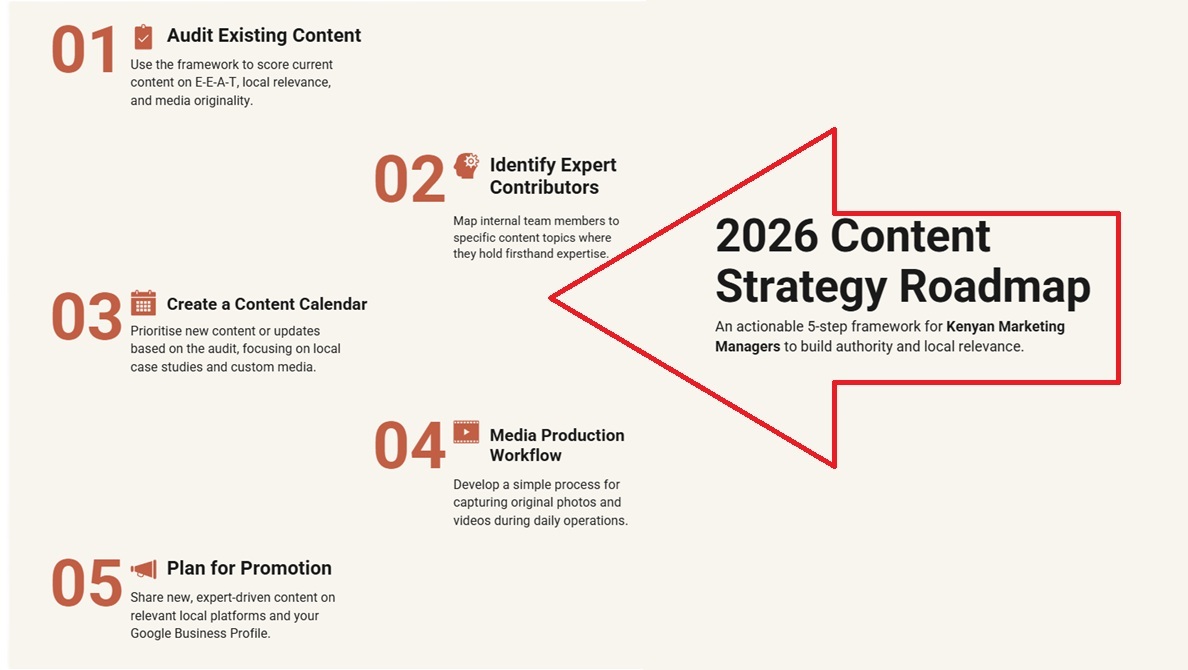
Kenyan marketing managers should create an actionable roadmap to integrate these principles. This plan provides a clear structure for content creation for 2026.
- Step 1: Audit Existing Content: Use the framework above to score current content on E-E-A-T, local relevance, and media originality.
- Step 2: Identify Expert Contributors: Map internal team members to specific content topics where they hold firsthand expertise.
- Step 3: Create a Content Calendar: Prioritise new content or updates based on the audit, focusing on local case studies and custom media.
- Step 4: Establish a Media Production Workflow: Develop a simple process for capturing original photos and videos during daily operations.
- Step 5: Plan for Promotion: Share new, expert-driven content on relevant local platforms and your Google Business Profile.
How to Measure the Impact of Your Prioritised Content Strategy
Kenyan businesses must track content performance to refine their strategy. Use Google Search Console to monitor search rankings, impressions, and click-through rates for new and updated pages.
In Google Analytics 4, track user engagement metrics like engaged sessions. Continuously improving these metrics is key to building and sustaining content authority in the Kenyan market.
[book an SEO consultation today]