Google's Penalties on EMDs in September 2026 Spam Updates
Google's September 2026 spam updates directly penalised websites that use an exact match domain (EMD) strategy. The updates devalued many EMDs, affecting their search visibility for Kenyan businesses. This action shows Google's focus on brand authority and quality content over simple keyword matching in a domain name.
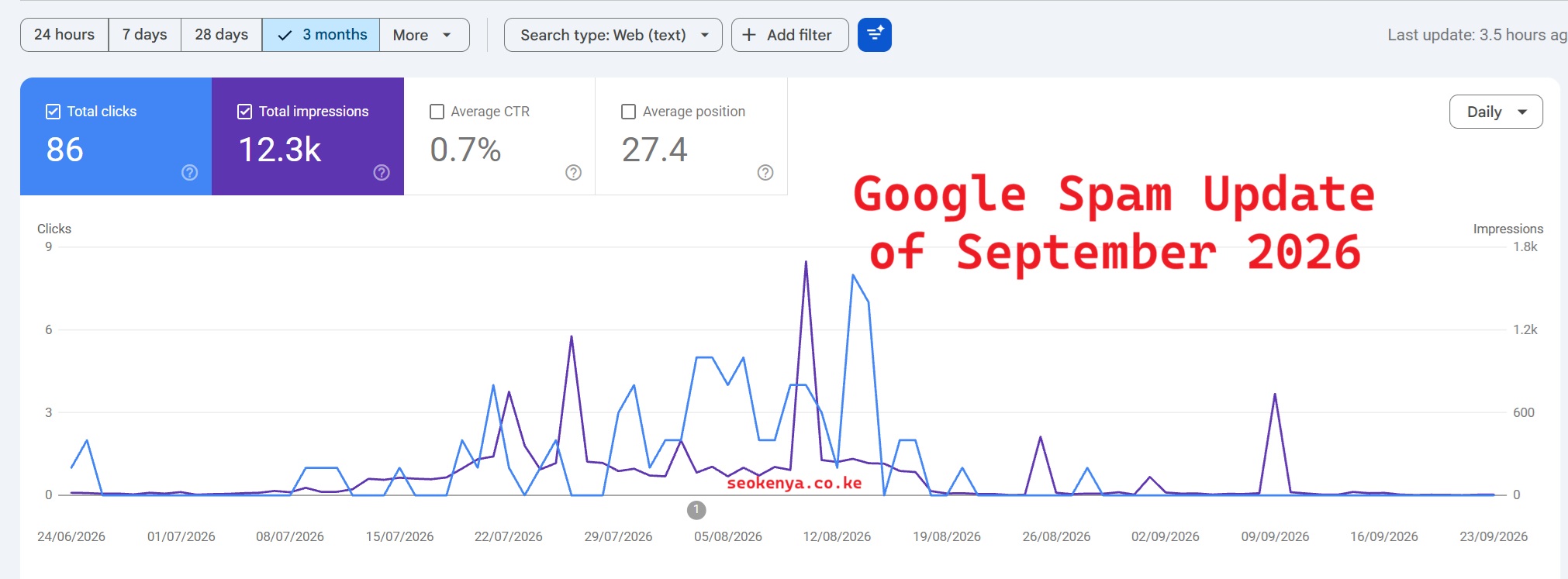 Industry analysis indicates the scale of these EMD penalties. Some reports suggest nearly half of tracked EMDs were negatively affected in the August 2026 update, with an additional 25% impacted by the September 2026 update. The penalties directly reduced organic traffic for businesses in Nairobi, Mombasa, and Kisumu.
Exact Match Domains and Why They Popular
An Exact Match Domain (EMD) is a domain name that perfectly matches a search query, such as cheap-laptops-nairobi.co.ke. Search engines historically rewarded EMDs with higher rankings because the keywords in the domain name signalled strong relevance. This tactic was considered a direct way to show a website's purpose.
Kenyan small and medium-sized enterprises (SMEs) frequently used EMDs as a low-cost method to gain search visibility. The strategy appeared to offer a shortcut past brand building and content marketing. An EMD communicated a core service directly to customers and search engines, which was appealing in a competitive local market.
Why Google September 2026 Spam Updates Penalised EMDs
Google's 2026 spam updates devalued websites that rely on low-quality ranking signals like EMDs. Data shows that the August 2026 update negatively impacted nearly half of tracked EMDs. The September 2026 update affected an additional 25% of those domains, suggesting Google now treats EMDs as a potential spam signal.
Google's rationale for the EMD penalties is to improve user experience. The search algorithm now prioritises authoritative brands, quality content, and user engagement. Many EMDs hosted thin content and had a poor site structure, offering little user value. Penalising these domains reinforces Google's policy of rewarding websites that build trust and demonstrate expertise.
How an EMD Penalty Manifests for Kenyan Businesses
An EMD penalty causes a sudden drop in organic traffic and the loss of rankings for core keywords. The penalty reduces local search visibility for Kenyan businesses, leading to fewer customer enquiries and sales. A devalued EMD can also lower a Google Business Profile's visibility in local map results.
Identifying Algorithmic vs Manual Penalties
An algorithmic penalty is an automated demotion from Google's systems for low-quality sites, which causes a drop in traffic without a direct notification. A manual penalty is applied by a human reviewer and triggers a notification in the 'Manual Actions' report in Google Search Console. The 2026 EMD penalties were mainly algorithmic, requiring performance data for diagnosis.
Impact on Organic Traffic and Search Visibility
A sharp drop in organic search traffic is the most direct symptom of an EMD penalty. You can verify this traffic decline in Google Analytics 4 by checking for a drop that matches the spam update dates. The traffic loss occurs because the website disappears from search results for its main keywords, reducing enquiries and sales for local businesses.
Why Google's EMD Penalties Affect Many Kenyan SMEs
The 2026 spam updates heavily impacted Kenyan businesses due to a historical reliance on EMDs as a marketing tool. SMEs believed owning a domain like plumbersinnairobi.co.ke was the most direct way to attract customers searching for that term. This approach was perceived to bypass the need for larger branding and content budgets.
This perception created a vulnerability by focusing on a single ranking signal. The strategy neglected foundational SEO elements like brand equity, valuable content, and genuine authority. These EMD sites often offered a poor user experience, making them targets for the spam updates. This misunderstanding of Google's direction meant many businesses built their online presence on a weak foundation.
What Immediate Steps Should You Take if Your EMD Is Penalised?
A business with a suspected EMD penalty should take three immediate actions. First, verify the penalty using Google Search Console. Second, audit content and technical SEO to find the cause. Third, decide whether to recover the existing domain or migrate to a new brandable domain.
Verifying the Penalty Status in Google Search Console
Google Search Console (GSC) is the first tool to use for verification. Check the 'Manual Actions' tab to rule out a manual penalty. In the 'Performance' report, look for a sharp drop in impressions and clicks around the August and September 2026 update dates. A sustained low level of traffic after a sharp drop indicates an algorithmic penalty.
Auditing Content Quality and Technical SEO
An EMD penalty signals that Google views your website as low-quality. Audit your content for thin pages, duplicated text, and keyword stuffing. Review technical SEO factors like mobile-friendliness, page speed, and user experience. Deficiencies in these areas are common on penalised EMD websites.
Considering a Website Migration to a Brandable Domain
Migrating to a new, brandable domain is often the best solution if the EMD itself is the problem. Recovery on a low-quality EMD can be difficult. A migration requires careful planning, including a complete 301 redirect map to transfer link equity. A new brandable domain provides a more stable foundation for long-term growth.
Domain Strategies that Work for Kenyan SEO After the 2026 EMD Penalties
Compliant domain strategies after the 2026 EMD penalties focus on long-term brand value. Two alternatives are brandable domains and descriptive domains. A brandable domain (e.g., Jumia) is a unique name that builds value through reputation. A descriptive domain (e.g., Kenya Pesa) includes a relevant term but focuses on the brand. Both approaches support brand equity and user trust better than an EMD.
Assessing Your Domain Strategy for Future Google Updates
A proactive audit of core quality signals is necessary to assess your domain strategy for future updates. Business owners should evaluate website health across four key areas. This evaluation helps build long-term authority that is independent of domain keywords.
- Brand Signals: Monitor direct brand name searches in Google Search Console. Check for unlinked brand mentions from reputable websites.
- Content Quality: Ensure your content demonstrates expertise and helps your Kenyan audience. The content must build authoritativeness and trustworthiness.
- User Engagement: Analyse user engagement metrics like time on site in Google Analytics 4. A high bounce rate indicates a poor user experience.
- Backlink Profile: Audit your backlinks to confirm they come from diverse, high-quality sources, not low-quality directories.
A regular review of these brand, content, user, and backlink signals builds a resilient online presence. A strong technical foundation, including mobile-first indexing and Core Web Vitals, also reduces susceptibility to algorithm updates.
How Businesses in Kenya can Adjust their Long-Term SEO Strategy
A sustainable long-term SEO strategy for Kenyan businesses requires three pillars. These pillars are authoritative content marketing, technical excellence, and local brand building. This approach moves away from SEO shortcuts toward creating a valuable online presence that serves users.
Businesses should first invest in high-quality content that solves problems for a Kenyan audience. Second, they must ensure the website's technical foundation provides a fast, secure, and mobile-friendly experience. Third, building local authority through an optimised Google Business Profile and local mentions creates a powerful brand signal. This brand signal is stronger than a keyword in a domain name. [Book an SEO consultation]
Key Takeaways on Google September Spam Update
| Factor | Impact of 2026 Updates | Recommended Action |
|---|---|---|
| Exact Match Domains (EMDs) | Treated as a potential spam signal; heavily devalued. | Migrate to a brandable or descriptive domain. |
| Organic Traffic | Sudden, significant drops for penalised EMDs. | Verify traffic loss in GSC and GA4. |
| Brand Signals | Prioritised over domain keywords for rankings. | Focus on building brand authority and user trust. |
| Content Quality | Thin or low-value content on EMDs was a penalty trigger. | Conduct a full content audit and improve quality. |