How to Get International Tours and Travel Clients via SEO in Kenya
Local Kenyan tour operators compete against global entities with large marketing budgets. Effective tours and travel SEO in Kenya sidesteps competition with global Online Travel Agencies (OTAs).
Operators should shift their strategy from broad terms like "Kenya safaris" to capturing UK and US travellers during their informational planning stage.
Operators achieve this by creating focused guides on logistics, such as "UK to Kenya packing list for kids," and linking this content to private booking engines.
 Addressing Global OTA Competition in Kenyan Tours and Travel SEO
Global OTAs such as Booking.com, Expedia, and Viator dominate search engine results pages (SERPs) for commercial keywords.
Their domain authority and advertising spend make direct competition for terms like "safari in Kenya" inefficient for a local operator. A Kenyan business cannot win a bidding or backlink war against these platforms.
Attempting to compete at the bottom of the marketing funnel, where OTAs are strongest, is a strategic failure. The opportunity for Kenyan operators is in the middle and upper funnel, where travellers seek answers to specific logistical questions.
Local expertise provides a clear advantage in this content space that OTAs cannot replicate at scale.
Identifying Niche Travel Keywords for Kenyan Tours and Travel SEO
This strategy depends on precise keyword research focused on a user's informational, not transactional, intent. The objective is to identify long-tail search queries that high-value international travellers use months before booking.
These queries often relate to safety, family needs, packing, and specific in-country logistics.
Examples include "malaria free safari kenya family," "best time to visit amboseli with toddlers," or "nairobi airport to wilson airport transfer time." These keywords have lower search volume but signal qualified interest from a target demographic.
A Kenyan operator can become a trusted authority by targeting these queries before the traveller searches for a booking platform.
Identifying these niche queries requires a combination of specialist tools and logical analysis. A business should start with a core topic, such as "family safari," and use keyword research tools to find questions and long-tail variations.
Pay close attention to modifiers that indicate a specific need.
Keyword Research Tools and Techniques
| Tool Type | Examples | Primary Function |
|---|---|---|
| Free Tools | Google Keyword Planner, AnswerThePublic | Broad idea generation and identifying question-based queries. |
| Paid Tools | Ahrefs, Semrush | Detailed analysis of keyword difficulty, search volume, and competitor content. |
| Community Research | Reddit (r/travel), TripAdvisor Forums | Finding real-world questions and language used by international travellers. |
Your technique should focus on appending modifiers to your core services, such as: "for families," "with young children," "for seniors," "accessible," or location-specific queries like "what to wear in Mombasa in July."
Creating SEO Content for Kenyan Tours and Travel Planning
Once you have a list of target keywords, the next step is to create helpful content that directly answers the user's query. This content must be authoritative and practical, establishing your brand as a knowledgeable local expert.
The primary purpose of this content is to build trust, not to sell a package on the first visit.
Developing Content Pillars and Topic Clusters
Organise your content creation around a content pillar and topic cluster model. A broad "pillar" page, such as a guide to "Family Safaris in Kenya," can target a general term.
This pillar page then links out to multiple "cluster" articles, each targeting a specific long-tail keyword you identified.
- Pillar Page: The Ultimate Guide to Family Safaris in Kenya
- Cluster Article 1: Fenced Safari Camps in the Masai Mara for Toddler Safety
- Cluster Article 2: A Complete Kenya Packing List for Families with Kids (UK Focus)
- Cluster Article 3: Choosing Between Malaria-Free Reserves: Laikipia vs. Shimba Hills
- Cluster Article 4: Private Safari Vehicle Costs and Benefits for a Family of Four
This structure helps search engines understand your website's topical authority on family travel in Kenya and improves internal linking. Better internal linking distributes page authority throughout your site.
Optimising On-Page SEO for Informational Guides
Each content piece must be correctly optimised to rank for its target keyword. Adhere to fundamental on-page SEO best practices for every informational guide you publish.
- Title Tag: Include the primary keyword, preferably near the beginning.
- Meta Description: Write a compelling summary of the article's content that encourages clicks from the SERP.
- URL Structure: Use a clean, simple URL that includes the target keyword (e.g., /fenced-camps-masai-mara/).
- Internal Linking: Link from the new article to your main service pages (e.g., your "Family Safari Packages" page) and to the central pillar page.
- Clear Headings: Use H2 and H3 tags to structure the content logically, making it easy for users and search engines to scan.
Direct Booking SEO Strategies for Kenyan Tour Companies
Informational content attracts the right audience; the next stage is to guide them towards a direct booking.
The transition must be natural, providing a clear path from the informational guide to your booking engine or contact form. This is how you convert the trust you have built into revenue.
Within your guide on "fenced safari camps," for example, include a clear call-to-action such as, "View our recommended family-safe safari itineraries" which links directly to a relevant package page.
This method bypasses OTAs and keeps the entire user journey on your website.
Using Structured Data for Direct Bookings
Structured data, or Schema markup, is code you add to your website to help search engines understand your content in greater detail. For tour operators, specific schema types are valuable for encouraging direct bookings from the SERPs.
Use `Product` or `Tour` schema on your package pages. This can enable rich results in Google Search, showing details like price, duration, and availability directly in the search results.
This feature makes your listing more prominent and provides transactional information to users who are ready to book.
Conversion Rate Optimisation for Booking Engines
Driving traffic to your booking engine is only half the task. The booking process itself must be simple and trustworthy for an international audience.
A poorly designed booking page will drive potential clients back to the perceived safety of a global OTA.
Focus on a mobile-first design, as many travellers plan and book on their phones. Clearly display pricing, inclusions, and payment options.
Acknowledging international payment methods alongside local options like M-Pesa can build confidence. Ensure your contact information, including a WhatsApp number, is clearly visible for quick enquiries.
Technical SEO for International Travel Websites in Kenya
Your website's technical foundation must be strong enough to serve a global audience effectively. A user in London or New York expects a fast, clean experience, and search engines reward websites that provide it.
Site Speed and Mobile-First Optimisation
Page speed is an important ranking factor. International audiences may access your site on varied network qualities. Use tools like Google PageSpeed Insights to diagnose and fix issues.
Compress images, enable browser caching, and minimise code to ensure your pages load quickly for users in the UK and US.
Your website must be built for mobile devices first. Google uses mobile-first indexing, meaning it predominantly uses the mobile version of your content for indexing and ranking. A non-responsive or difficult-to-use mobile site will perform poorly in search.
Server Location and CDN Considerations
The physical location of your web server can affect loading times for international visitors. A website hosted on a server in Nairobi will load slower for a user in Manchester. To solve this, use a Content Delivery Network (CDN).
A CDN stores copies of your website in multiple servers around the world. When a user from the US visits your site, the CDN serves the content from the geographically closest server.
This process dramatically reduces latency and improves page load speed for any business serious about international SEO.
Measuring SEO Success for International Travel Clients in Kenya
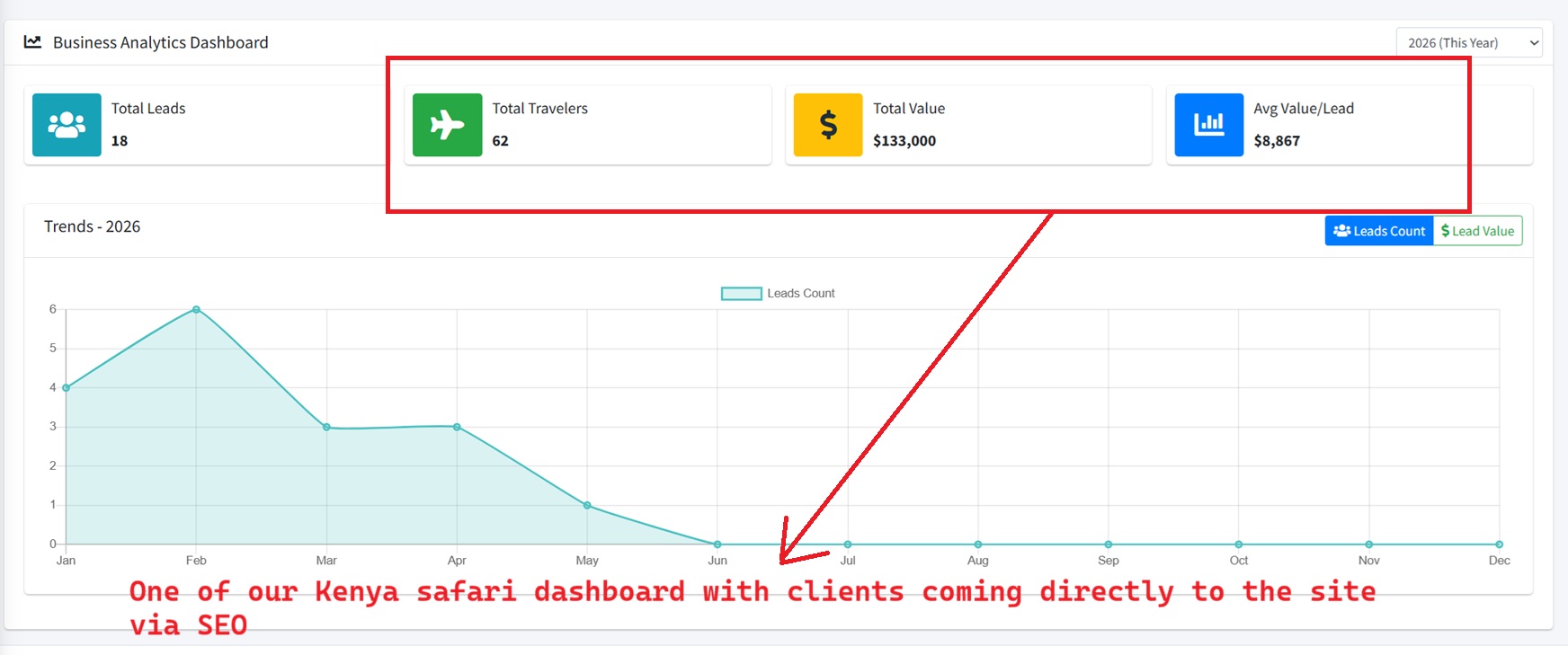
To measure the return on this SEO strategy, you must track the correct metrics. Success is not measured by overall traffic, but by tangible business outcomes from your target international markets.
Key Performance Indicators for International SEO
Focus on Key Performance Indicators (KPIs) that connect SEO effort directly to business goals. This connects SEO activity to revenue.
- Organic traffic segmented by country: Is traffic from the UK and US increasing?
- Conversions from organic traffic: How many direct bookings or lead form submissions originate from organic search?
- Conversion rate by country: Are UK visitors converting at a higher rate than visitors from other countries?
- Visibility for informational keywords: Track your rankings for the specific long-tail queries you are targeting.
- Assisted conversions: How many times did an informational blog post contribute to a later booking?
Using Google Analytics 4 and Search Console
These two free tools are necessary for measurement. Use Google Search Console to monitor your keyword performance and click-through rates, filtering the Performance report by country to isolate your UK and US audiences.
In Google Analytics 4 (GA4), set up conversion events for bookings or contact form submissions. Use the traffic acquisition reports to see how much converting traffic comes from your organic SEO efforts.
Multilingual SEO for Kenyan Tourism in 2026 and Beyond
A strategy for 2026 should include diversifying into other high-value European markets beyond the UK and US.
Germany and France are significant sources of tourism revenue for Kenya, but many local operators lack content in German or French.
This section outlines how to approach translation and localisation for new markets.
Using AI for Translation and Native Refinement
Professional translation was previously too expensive for many Kenyan businesses. In 2026, AI tools such as Google Translate's API can provide an accurate first draft of translations for key informational pages.
This method is cost-effective: use the AI for the initial translation and then hire a native speaker on a freelance basis to review and refine the content for cultural nuance. This process makes entering new language markets more accessible.
Core Components of an International SEO Strategy for Kenyan Tour Operators
Success requires a structured approach that moves beyond traditional keyword targeting. The table below summarises the main components of a modern, effective SEO strategy focused on attracting high-value international clients.
| Strategy Component | Primary Goal | Example Tactic |
|---|---|---|
| Niche Keyword Research | Attract qualified users in the planning phase. | Target "fenced family camps in Masai Mara". |
| Topical Authority | Build trust and demonstrate expertise to search engines. | Create a "Family Safaris" pillar page with cluster content. |
| Direct Booking Path | Convert informed traffic, bypassing OTAs. | Link informational guides to specific package pages. |
| Technical Performance | Provide a good user experience for a global audience. | Use a Content Delivery Network (CDN) for fast load times. |
Key Actions for International Tours and Travel SEO in Kenya
Executing this strategy requires a focused, long-term commitment to creating valuable content and ensuring your technical foundation is sound.
The final actions involve building your site's authority and optimising your local presence for an international audience.
Building Website Authority with Targeted Backlinks
Authoritative backlinks are signals of trust to search engines. Instead of pursuing low-quality links, focus on acquiring links from relevant international sources.
A practical approach is to offer your expert opinion or provide unique photos to UK or US-based family travel bloggers who are writing about Kenya. This method builds relevant links that drive qualified referral traffic.
Optimising Your Google Business Profile for Tour Operators
Your Google Business Profile (GBP) is an important business asset. Ensure it is fully completed with high-quality, recent photos and videos of your tours.
Actively encourage reviews from your international clients, as positive social proof is highly influential.
Use the Q&A feature proactively by posting and answering common questions that international travellers may have about booking with a Kenyan company. This work builds trust and provides helpful information directly on the SERP.